


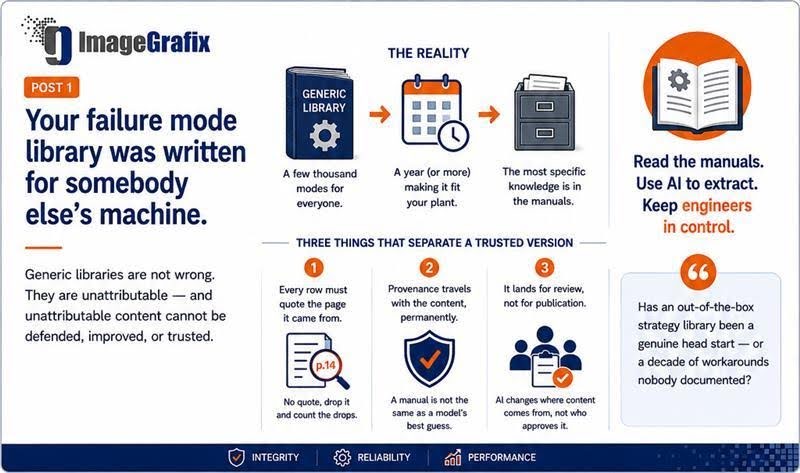
The majority of asset performance management (APM) platforms include an asset strategy library (ASL) – a pre-built collection of maintenance templates, failure data, and best practices for an industrial equipment. That’s a good thing.
After all, a reliability team is in a much better position than having to start from scratch because of years of engineering knowledge, a understanding of the ways in which things fail, recommended maintenance tasks, and proven practices.
The issue isn’t the library you begin with. The issue lies in what occurs to it later on.
A typical asset strategy library shows the state of knowledge at the time the strategy was developed. The OEM puts forward a revised suggestion regarding maintenance. The library gives you a solid base to start from.
Your plant, on the other hand, is constantly changing. You put in a different pump setup. Your work environment and working conditions are different. Operating conditions changed. A seal breaks down before it should. The inspection reveals a degradation mechanism that you had not expected. A single failure triggers a warning which the original strategy had never taken into account.
The question you should ask: Is the asset strategy library acquiring knowledge from it?
What you needs is an asset strategy library which is alive and keeps becoming more relevant as regards to the equipment that you actually own. That’s where AI comes in.
What arrives with a new piece of equipment:
- OEM manuals.
- Maintenance instructions.
- Inspection procedures.
- Troubleshooting guides.
- Service bulletins.
- Recommended intervals.
- Failure descriptions.
- Operating limits.
Normally, a great deal of that knowledge never gets fed back into the asset strategy library. So picture a more dynamic, AI-enabled model…
ASL (starting point)→ OEM knowledge (knowledge ingestion)→ plant experience (operating conditions)→ continuously improving strategy (relevant not theoritical)
A machine arrives at your premises. AI studies the machine’s manual and determines which of its components are maintainable, what its possible points of failure are, the mechanisms by which it may degrade, the methods that are recommended for detection and the intervals at which maintenance should be carried out
It doesn’t merely replace the existing strategy. It compares. Your reliability engineer now possesses something far more valuable than just another suggestion. They have the evidence required to determine if the strategy should change. And every accepted change retains its provenance:
- What origin does this recommendation have?
- What document and what page give support for it?
- To which asset does it apply?
- What plant evidence is there to support the change?
- Who reviewed it?
- Who approved it?
The static asset strategy library ceases to be the final answer and instead becomes the maintenance baseline. What you need is the next generation of APM that constantly learns from the machines which your organization owns.
Here, AI is not taking the place of engineering judgement. It is learning from the experience of maintenance, inspections, and keeping records of the machine’s condition. It is ensuring that engineering judgement is working in conjunction with all the available evidence.
When you are in the market, looking for a smarter, AI-enabled APM solution, don’t forget to ask: What has your APM and asset strategy library picked up from machines over the past twelve months? After all, you need a smarter version of the asset strategy library for your greater performance.
#AssetPerformanceManagement #AssetStrategy #AssetIntegrity #APM #AI #ReliabilityEngineering #IndustrialAI #RCM #ISO14224 #PredictiveMaintenance #OctaveAttune
FAQs
What is an Asset Strategy Library?
An asset strategy library (ASL) is a structured collection of maintenance strategies, equipment information, failure modes, inspection activities, and reliability practices that can be used as a foundation for developing asset maintenance programs.
Why can an asset strategy library become outdated?
The library itself may not necessarily become technically incorrect. The bigger issue is continued relevance. Equipment modifications, operating conditions, inspection findings, failure experience, and revised OEM recommendations can make an original maintenance strategy less representative of actual plant conditions.
How can AI support asset performance management (APM)?
AI can assist with analyzing large volumes of maintenance documentation, inspection information, equipment history, and operating data. It can help engineers identify relevant information, compare recommendations and highlight areas that may deserve further investigation.
Can AI automatically change an asset maintenance strategy?
Maintenance strategies affect safety, reliability, cost and operational risk. Any AI-proposed change should remain subject to appropriate engineering review, validation and approval.
Why is auditability important in AI-enabled APM?
Engineers need to understand the basis of a recommendation. AI-auditability can show which source document, equipment information, inspection finding or maintenance history contributed to a proposed change.